
If you are coming to Japan on a Working Holiday visa and want to work, your usual CV is not enough on its own. Most Japanese employers expect a rirekisho, the standard Japanese resume: a fixed-format form with a photo, your date of birth and address, and one chronological table for your education and work history. The good news is that the differences are about format and custom, not about your experience. Once you know the rules, you can prepare a Japanese resume with confidence. This guide explains the key differences, and what to have ready before you start applying.
1. The format: a fixed form, not a free design
A Western CV is free-format. You choose the layout, the order of sections, the fonts and colours, and many people use it to show personality and sell their achievements.
A rirekisho is the opposite. It is a standard template with the same boxes in the same order for everyone. Printed forms are sold at convenience stores in Japan, and free templates are easy to find online. Because every applicant fills in the same form, employers can compare candidates quickly and fairly. What matters is not design, but that the form is neat, complete and accurate.
2. The photo is not optional
In the top corner of a rirekisho there is a space for an ID photo, and leaving it empty makes the document look unfinished. The standard is:
- Size 3 × 4 cm
- A plain background
- Business attire, such as a jacket or suit
- No hat, sunglasses or casual clothing, and a recent photo
This surprises many people, because Western CVs usually leave photos out. In Japan, photo booths for ID photos (called shomei shashin) are found at stations and near convenience stores, so it is easy to take a proper one after you arrive.
3. Personal details: more than you may expect
A rirekisho asks for personal details that Western CVs often leave out for privacy reasons: your date of birth (and age), your current address, and your phone number, as well as your name and email address. There is also a space for a second contact address, if it is different from where you live.
On a Japanese resume, these fields are simply expected. Leaving them blank does not look private; it looks incomplete. Fill in every box that applies to you.
4. One chronological table for school and work
Your education and work history go into a single table on the rirekisho, written in chronological order, oldest first. For each entry you write the year and month you entered and graduated from a school, or joined and left a job. Use the full, official names of schools and companies, without abbreviations.
This is the reverse of a Western CV, which usually starts with your most recent job. On a rirekisho, your story reads from the beginning to today. A common finishing touch is to write the word ijou (meaning “that is all”) on the line below your last entry, to show the list is complete.
5. The second document: shokumu-keirekisho
The rirekisho only lists where you studied and worked, and when. It has no room for what you actually did, so Japanese applications often include a second document: the shokumu-keirekisho, a work-history document in free format. This is where you describe your duties, skills and achievements in detail.
A simple way to remember it: the rirekisho is the form, and the shokumu-keirekisho is the story. For part-time jobs, the rirekisho alone is often enough. For full-time roles, or if you have experience you want to show, prepare both.
6. Small conventions that catch people out
A few unwritten rules are worth knowing before you apply:
- Reasons for leaving: the rirekisho asks why each job ended. If you left by your own choice, the standard phrase is “for personal reasons” (isshinjo no tsugou ni yori). Almost everyone writes this, whatever the real story was.
- No references: Japanese resumes do not include a references section, and there is no need to write “references available on request.”
- The date: write the date you submit or post the resume at the top of the form, and keep one date style all the way through the document.
- Length: a rirekisho is usually one to two A4 pages. Short and complete is better than long and padded.
Checklist: before you apply
- Download a standard rirekisho template (Word, Excel or PDF versions are easy to find).
- Take your ID photo: 3 × 4 cm, plain background, business attire.
- List your schools and jobs in order, oldest first, with years and months.
- Fill in your personal details, including your date of birth, your address in Japan and your phone number.
- Prepare a shokumu-keirekisho if you have work experience you want to explain.
- Keep your English CV as well. Some international companies ask for it instead, and it is useful to have both versions ready.
- Write the submission date at the top, and do a final check for gaps and spelling.
FAQ
Q. Can I just send my English CV?
A. Some international companies in Japan accept one, but most Japanese employers expect a rirekisho. If you prepare both, you can apply anywhere without rushing at the last minute.
Q. Does a rirekisho have to be handwritten?
A. Handwritten resumes used to be the norm, and some employers still like them. Typed resumes are now widely accepted, and templates are easy to find. If a job posting asks for a handwritten resume, follow that instruction.
Q. I am on a Working Holiday with little work experience. Do I still need a shokumu-keirekisho?
A. Not always. For many part-time jobs, the rirekisho on its own is fine. If you have any experience worth describing, even from your home country, a short shokumu-keirekisho can help an employer understand what you can do.
How JAPOW can help
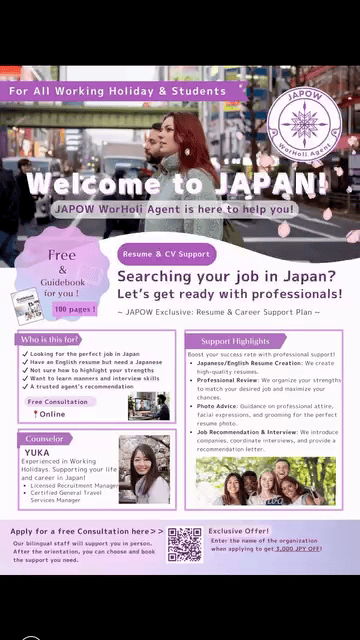
Writing a rirekisho for the first time can feel fiddly: the fixed form, the dates, the set phrases, the photo rules. JAPOW WorHoli Agent supports working holiday makers and students starting their life in Japan, with help for housing, jobs, SIM cards and more. Our Resume Support includes Japanese and English resume and CV creation, a professional review that brings out your strengths, advice on your resume photo, and job matching with a recommendation letter from us.
If you are not sure where to start, begin with a free online orientation. Tell us about your plans, and we will suggest the support that fits you.
Free online orientation and Resume Support: https://japow-agent.studio.site


Leave a Reply